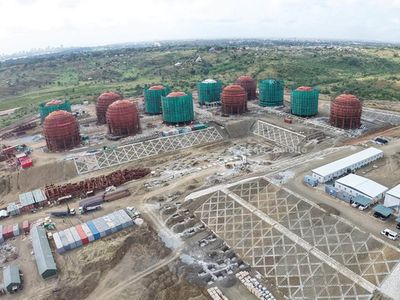
DAR ES SALAAM — A Sh320 billion liquefied petroleum gas (LPG) import terminal being developed by Tanzania's Taifa Gas at the Dongo Kundu Special Economic Zone in Mombasa is nearing completion, positioning the company to reshape Kenya's cooking gas market and establish Mombasa as a major LPG logistics hub for East Africa. The project has entered its final phase, with Taifa Gas carrying out hydrostatic testing—one of the most critical safety procedures for pressurised LPG storage vessels—ahead of commissioning the facility in the coming months. The mandatory tests are being witnessed by inspectors from Kenya's Energy and Petroleum Regulatory Authority (EPRA), the Kenya Bureau of Standards (KEBS) and other government agencies before the terminal receives final operational approval. Taifa Gas Site Manager Anthony Musyoka said the project had reached its final commissioning stage after several years of construction. "We are carrying out hydro tests, which are mandatory for pressurised vessels. The government has been very cooperative. We have EPRA and KEBS on site witnessing the testing of the first tank. Pipeline installation is progressing well, all materials have been delivered and contractors remain on site. The Kenya Ports Authority has also provided all documentation required for the marine connection," he said. Mr Musyoka said extensive engineering works had transformed what was once rugged terrain overlooking Mombasa's southern channel into one of the region's largest LPG storage facilities. Construction of the storage tanks has been completed, while electrical systems, instrumentation and product pipelines are in the final stages of installation. Once operational, the facility will become East Africa's largest LPG storage terminal, with an initial capacity of 30,000 metric tonnes stored in 12 spherical pressurised tanks. The 30-acre site has also been designed for future expansion to 45,000 metric tonnes. Beyond its scale, the investment is expected to transform Kenya's LPG market by increasing competition in a sector that has long been dominated by two bulk importers. For more than two decades, Kenya's bulk LPG import business has remained one of the country's most concentrated energy markets. Industry data shows that African Gas and Oil Company (AGOL), owned by Mombasa businessman Mohammed Jaffer, handled about 208 million kilogrammes of LPG during the six months ending December 2025, accounting for nearly 90 percent of all imports. Lake Gas, another Tanzanian investor operating a 10,000-metric-tonne terminal in Vipingo, Kilifi County, handled approximately 22 million kilogrammes over the same period, leaving the two companies controlling more than 98 percent of Kenya's imported cooking gas. The concentration has attracted criticism from industry players, who argue that limited competition has kept wholesale handling costs high and discouraged investment in new import infrastructure. Taifa Gas expects the Dongo Kundu terminal to change that market structure. Unlike operators that depend on shared infrastructure, the new terminal will allow the company to receive very large LPG carriers directly, reducing reliance on third-party facilities while lowering shipping and handling costs. Kenya's Cabinet Secretary for Investments, Trade and Industry, Lee Kinyanjui, described the project as a strategic milestone in the country's ambition to become the region's energy gateway. "Our role as government is to create incentives for private investors. This project will be a game changer. Instead of importing gas from Tanzania and elsewhere, Mombasa will become the logistics hub serving Kenya and neighbouring countries. In the next three months, we expect operations to begin, making Taifa Gas the first major investor to commence operations inside the Dongo Kundu Special Economic Zone," he said. Government officials believe the terminal will strengthen Kenya's position in regional energy trade while accelerating industrialisation within the Special Economic Zone. Construction of the project was delayed after residents challenged its environmental and safety approvals in court. However, Kenya's High Court dismissed the petition in late 2025, allowing construction to resume. For Taifa Gas, the Mombasa investment forms part of a broader regional expansion strategy. The company already operates major LPG import terminals in Dar es Salaam and Zanzibar. The addition of Mombasa will create an integrated three-port distribution network along East Africa's Indian Ocean coastline. Taifa Group chairman Rostam Aziz said the network would strengthen regional energy security by enabling supplies to be moved quickly between the three ports whenever shortages arise. "When gas runs low in Mombasa, it can be supplied from Dar es Salaam, and when Dar es Salaam faces shortages, it can be replenished from Mombasa. Zanzibar will also benefit from the same network," he said during the recent Kenya-Tanzania Business Forum. The integrated network is expected to improve logistics by enabling large LPG cargoes arriving from the Middle East to be distributed across multiple ports, rather than relying on separate national supply chains. It is also expected to strengthen Taifa Gas' bargaining power with international suppliers by consolidating regional demand into larger procurement volumes. Until now, Taifa Gas has largely served the Kenyan market by transporting LPG cylinders across the Tanzania-Kenya border by road, a model constrained by transport costs and limited carrying capacity. The Dongo Kundu project also reflects the growing role of private investment in driving East African integration, with regional firms increasingly investing in infrastructure that physically connects markets rather than simply exporting products. Taifa Gas has also expanded upstream after agreeing to acquire a 49 percent stake in PanAfrican Energy, the operator of Tanzania's Songo Songo natural gas field, strengthening its position across the energy value chain—from natural gas production to regional LPG distribution.
"We aggregate wires to encourage regional discovery, sending readers directly back to the original source to explore full coverage."
This is a normalized overview of the breaking feed event. The complete, official release detailing all points, background context, and statements remains hosted by the original publisher.