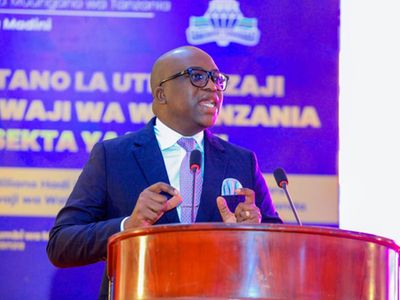
DAR ES SALAAM — Minister for Minerals Anthony Mavunde has said Tanzanians are increasingly taking leading roles in the mining sector, occupying key positions in mining companies, employment and leadership, a development he said demonstrates the success of the local content policy. Speaking on Wednesday, July 22, 2026, while opening the Fifth Local Content Compliance Forum (LCCF) in the Mining Sector here, Mr Mavunde said the current situation was different from previous years when Tanzanians had limited opportunities to participate in mining operations. He said there had been widespread complaints from citizens over their exclusion from the sector, with even basic supplies such as food being imported despite their availability locally. "There was an outcry from Tanzanians that we were missing opportunities to supply goods and services to many mines. At times, even chickens and eggs were imported from abroad. That was the situation Tanzanians experienced regarding local content, and it caused major concern," he said. Mr Mavunde said it was unacceptable for large foreign companies investing in Tanzania to operate without Tanzanians benefiting meaningfully, despite the country's natural resources and available opportunities. He said after listening to those concerns, the government issued directives aimed at ensuring Tanzanians participate fully in the mining sector. "Today, following proper enforcement of the law and its regulations, we are beginning to see these benefits. Tanzanians now hold positions and are at the forefront of the mining sector," he said. Mr Mavunde said statistics showed more than six million Tanzanians participate across the mining value chain, while formal employment in the sector stood at 20,421 workers, with Tanzanians accounting for 16,695, representing 96 percent of formal employees. He said there had also been significant transformation in leadership positions, noting that in the past it was rare to find Tanzanians holding senior positions in mining companies. On procurement of goods and services, he said mining companies spend large amounts of money on supplies. "Mines in Tanzania spend Sh5.1 trillion purchasing goods and services. As a ministry, we have set targets to ensure 90 percent of that Sh5.1 trillion remains in Tanzania for Tanzanians," he said. He said the policy was not intended to discriminate against investors but to ensure Tanzanians benefit more from the country's mineral resources. "I request that this should not be interpreted as discrimination. I will firmly oversee efforts to ensure more Tanzanians benefit from the mining sector," he said. Addressing concerns over changes to mining laws, Mr Mavunde said no new legislation had been introduced, but the government was enforcing the existing 2017 law. "Let us read Section 133 of the Mining Act, which addresses local content, Tanzanian participation and corporate social responsibility. What we are doing today comes from the 2017 legislation," he said. He said the section prioritises Tanzanian participation, but some investors had exploited loopholes. "There was deception here. Those who wanted to form partnerships entered the country, found taxi drivers and asked them to sign agreements for that 20 percent, then claimed they had complied with the law," he said. Mr Mavunde said regulations had since been amended to ensure local content partnerships were genuine. "Regulation eight, sub-regulation three on local content has been amended. When partnering with a Tanzanian, you must be in the same line of business," he said. "If it is an explosives company, find a Tanzanian who owns an explosives company, not otherwise. We have addressed that challenge," added Mr Mavunde, promising that his ministry would continue monitoring implementation of local content laws. He added that some companies had recently been given one year to exit, transfer skills and allow Tanzanians to take over activities as part of enforcing local content regulations. Mr Mavunde urged companies to comply with the law, saying no one was above it, while calling on Tanzanians to provide quality services and not rely solely on nationality. Mining Commission Chairperson, Dr Janet Lekashingo, said the forum remained important in strengthening Tanzanian participation in the mining sector. She said the number of companies submitting local content plans had increased from 51 in 2018 to 1,312 in 2025, representing a 96.1 percent rise. Geita Gold Mining Limited human resources manager, Mr Dominick Marandu, said the company employs Tanzanians across different fields, with 98 percent of its 7,000 workers being Tanzanians. "Ninety-seven percent of purchases made in the first half of 2026 were from local companies," he said. He said the company works closely with the Mining Commission to approve and engage service providers in line with local content laws. "We have been providing opportunities for young people beyond employment. For example, through our Graduate or Internship Programme, more than 300 young people have benefited over the past seven years. Currently, we take university graduates for one year of workplace learning, and when employment opportunities arise, they are hired," he said.
"We aggregate wires to encourage regional discovery, sending readers directly back to the original source to explore full coverage."
This is a normalized overview of the breaking feed event. The complete, official release detailing all points, background context, and statements remains hosted by the original publisher.