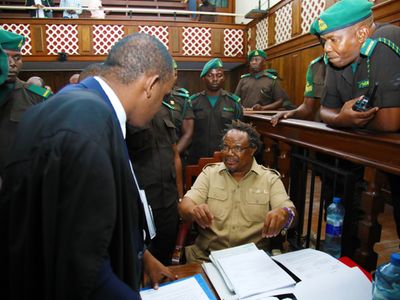
DAR ES SALAAM — Two witnesses in a constitutional petition filed by lawyers representing Chadema national chairman Tundu Lissu have told the High Court Main Registry in Dodoma that Ukonga Prison officers prevented them from handing documents to their client, including one from the Commonwealth. The witnesses, who are also applicants in the petition, Nashon Nkungu and Paul Kisabo, described the lack of privacy during consultations with Mr Lissu at Ukonga Prison and the restrictions they encountered while handling his legal matters. They gave the testimony on Tuesday, July 21, 2026, while being cross-examined by Mr Lissu over claims contained in the petition and supporting affidavits. The other applicant in constitutional petition No. 7300 of 2026 is Advocate Kulwa Maduhu. The respondents are the Attorney General (AG), the Commissioner General of Prisons (CGP), the Officer in Charge of Ukonga Prison, and Mr Lissu, who has been joined as a necessary party. The Tanganyika Law Society (TLS) is an interested party. The applicants, who identify themselves as Mr Lissu's legal advisers, argue that the Officer in Charge of Ukonga Prison failed to enforce Regulation 13 of the Prison Regulations, which guarantees advocates the right to consult clients privately and without interference. The petition is being heard by a three-judge bench comprising Justice Amir Mruma, who chairs the panel, Justice Dr Angelo Rumisha and Justice Dr Everist Longopa, sitting in Dar es Salaam. The court had scheduled both the petition and a preliminary objection raised by the government for written submissions, but granted Mr Lissu permission to cross-examine the applicants and the third respondent, the Officer in Charge of Ukonga Prison. Mr Lissu first questioned Advocate Maduhu before proceeding with Nkungu and Kisabo on Tuesday. Throughout the cross-examination, Mr Lissu sought to establish that the witnesses are members of his legal team in his pending criminal cases. The cases involve publishing false information online before the Kisutu Resident Magistrate's Court and treason before the High Court Sub-Registry in Dar es Salaam. He also asked them to describe the conditions under which they met him in prison and whether documents they intended to deliver were confiscated by prison officers. Before proceedings began, Justice Mruma asked Mr Lissu whether he was comfortable with his seating arrangement, to which he replied in the affirmative. Mr Lissu sat alongside the lawyers at the advocates' table rather than in the dock because the proceedings are civil rather than criminal. Advocate Nkungu confirmed that he is among Mr Lissu's advocates in both pending criminal cases and had visited him at Ukonga Prison 13 times. During the cross-examination, Advocate Nkungu confirmed he had all documents relating to the petition and that court records in both the High Court and Kisutu cases recognised him and Advocate Kisabo as members of Mr Lissu's legal team. He also confirmed he had never been denied access to Mr Lissu and that his name appeared on the prison's list of approved advocates. However, he told the court that between April 18 and June 16 consultations took place through a glass partition using a landline telephone while prison officers remained nearby. After June 16, 2026, consultations were moved to the inmates' registry office, where guards and CCTV cameras were present, before later shifting to the Deputy Officer in Charge's office, where prison officers also remained during discussions. Advocate Nkungu further testified that among the documents brought for Mr Lissu was the report of Judge Chande's Commission, but prison officers confiscated it before it reached the prisoner. Asked whether Mr Lissu could adequately prepare his defence without receiving the report, Advocate Nkungu replied that he could not. Senior State Attorney Stanley Kalokola, appearing for the first, second and third respondents, challenged Advocate Nkungu on prison security procedures. Advocate Nkungu agreed that the Mandela Rules do not prescribe the size of consultation rooms and that the Prisons Act allows visitors entering prisons to be searched. However, he maintained that laws governing legal practice protect confidential communication between advocates and clients and do not permit prison officers to inspect privileged legal documents. Advocate Kisabo also confirmed he had repeatedly visited Mr Lissu at Ukonga Prison and had taken him money for food and other necessities, which he handed to prison officers. He testified that court records identify him as one of Mr Lissu's advocates and that he was under no obligation to prove his status to the Officer in Charge because doing so could compromise advocate-client privilege. Advocate Kisabo further told the court that he brought Commonwealth documents relating to Mr Lissu's case, but prison officers seized them, read them and prevented him from handing them to his client without giving any explanation. Mr Lissu also complained that when he is brought to court to face the treason case, his lawyers are not allowed to consult him while he remains in custody, making it difficult to exchange legal documents. The hearing continues today, Wednesday, July 22, 2026, when the Officer in Charge of Ukonga Prison is expected to testify.
"We aggregate wires to encourage regional discovery, sending readers directly back to the original source to explore full coverage."
This is a normalized overview of the breaking feed event. The complete, official release detailing all points, background context, and statements remains hosted by the original publisher.